
Manuscript submission guide
Journal submission checklist: 7 checks before you upload
A practical, journal-neutral review for authors who want to reduce avoidable technical returns and make the manuscript package easier for an editorial office to assess.
Manuscript submission guide
A manuscript can pass an online submission form and still be technically incomplete. The useful question is not only whether every field can be filled, but whether the uploaded files tell one consistent story: the same study, the same authorship information, the same references, and the same reporting decisions across every document.
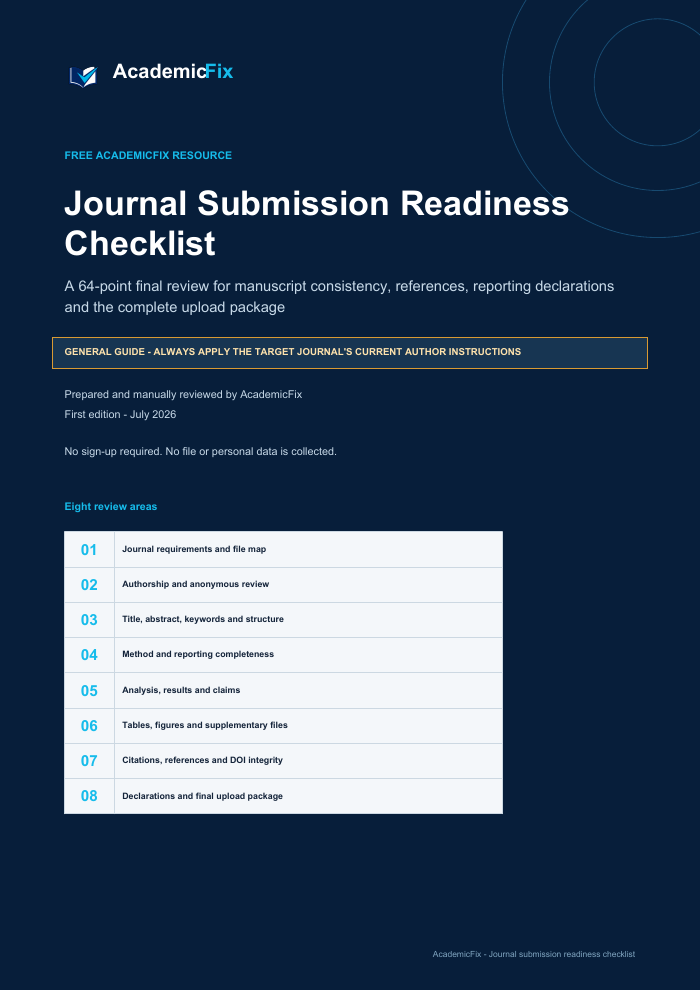
Free downloadable resource
64-point journal submission readiness checklist
Work through the complete submission package with a printable checklist, readiness scorecard and issue log. No sign-up or email address is required.
AcademicFix
Quick checklist
- 01
Use the target journal’s current author instructions—not a saved copy from an earlier submission.
- 02
Separate title-page information from the blinded manuscript when peer review is anonymous.
- 03
Reconcile every in-text citation with one reference-list entry after the final revision.
- 04
Check that tables, figures, captions, callouts and supplementary files agree.
- 05
Trace the research question through method, analysis, results and conclusion.
- 06
Include the ethics, funding, conflict, data and author-contribution statements requested by the journal.
- 07
Open the final files as a reviewer would and inspect the complete upload package.
1 / 7
Confirm the current journal requirements
Start from the journal’s live author-guideline and submission pages. Requirements can change even when an old template still circulates online. Record the article type, word limits, abstract structure, reference style, table and figure rules, required declarations, supplementary-file policy and accepted file formats.
Turn those requirements into a short file-specific map. A general checklist is useful, but the named journal’s rules decide what belongs in the title page, manuscript, cover letter and submission form.
- Article type and word-count method confirmed
- Current template or style files downloaded
- Required declarations and separate files listed
2 / 7
Protect anonymous review and align authorship details
For double-anonymous or single-anonymous review, inspect more than the visible author line. Names, affiliations, acknowledgements, self-identifying file properties, tracked changes, comments and institutional references can reveal identity.
At the same time, the separate title page and submission system should agree on author order, corresponding-author details, affiliations, ORCID values and contribution statements. Resolve inconsistencies before upload rather than asking the editorial office to infer the intended record.
- Blinded manuscript contains no unintended identifiers
- Author order and affiliations match across all files
- Tracked changes, comments and document properties inspected
3 / 7
Check the abstract, keywords and heading structure
The abstract should follow the journal’s required format and remain consistent with the full manuscript. Verify sample size, setting, measures, central results and conclusion language against the main text. A number changed during revision should not survive in only one location.
Keywords should add discoverability rather than simply repeat every word in the title. Heading levels should form a logical hierarchy and remain consistent in wording, numbering and style.
- Abstract facts match the final manuscript
- Keywords follow number and formatting limits
- Heading levels are complete and logically nested
4 / 7
Reconcile tables, figures and supplementary files
Every table and figure cited in the text should exist, appear in a sensible order and carry a matching caption. Check units, abbreviations, decimal precision, sample sizes and statistical labels across the visual, caption and narrative.
Supplementary files require the same care. Their filenames, numbering and in-text references should be stable, and any material needed to interpret the primary results should not be hidden in an inaccessible or unexplained attachment.
- All visuals are cited in numerical order
- Captions explain abbreviations and essential notes
- Values agree between visuals and the results text
5 / 7
Run a final citation–reference reconciliation
Compare in-text citations against the reference list in both directions. Each citation needs one traceable entry, and each listed source should be used in the current manuscript. Revisions often leave deleted sources in the list or remove an entry that still appears in the text.
Resolve DOI links and match them to the cited work rather than merely checking that a DOI-shaped string exists. Author names, year, title and source details should identify the same publication.
- No cited source is missing from the reference list
- No unused reference remains after revision
- DOI and bibliographic metadata identify the cited work
6 / 7
Trace method–analysis–result consistency
The research question, design, sample, variables and analysis plan should lead visibly to the reported results. Check that every primary outcome has a described method and that the conclusion does not claim more than the analysis supports.
This is not a substitute for peer review or a scientific-validity assessment. It is an internal-consistency check: labels, sample sizes, hypotheses, model names and reported statistics should remain stable across sections.
- Research questions and reported analyses correspond
- Sample sizes and exclusions are consistent
- Conclusions stay within the evidence reported
7 / 7
Inspect declarations and the final upload package
Complete the ethics, consent, funding, conflict-of-interest, data-availability and author-contribution statements required for the study and journal. A declaration should be accurate, not copied mechanically from another paper.
Finally, open every upload file after conversion. Confirm filenames, order, page completeness, readable fonts, working hyperlinks and the absence of comments or hidden material. Compare the final package with the requirements map created in step one.
- Required transparency statements are present and accurate
- PDF or converted files were opened and visually inspected
- The upload package matches the journal requirements map
Manuscript submission guide
FAQ
Does completing this checklist guarantee peer review or acceptance?
No. It reduces avoidable technical problems and makes the submission record clearer, but editorial screening, scientific evaluation and publication decisions remain with the journal.
Should I format the manuscript before choosing a journal?
You can clean the document and references in advance, but final formatting should follow a named journal and article type. Otherwise, you may spend time applying rules that must be reversed.
Can a technical review be completed without rewriting the paper?
Yes. Formatting corrections and traceable editorial observations can be separated from substantive decisions. The author remains responsible for the argument, interpretation and scientific choices.